A 42-Product Industrial Catalog That Collects Quotes, Not Carts
How I turned Framer's Pseudo Cart, an add-to-cart tool built for stores, into a quote-request funnel for CWOLF Industries, an industrial coatings supplier, on a catalog that now pulls steady search traffic and regular quote submissions.
Design + Framer Development
At a glance
Client: CWOLF Industries (industrial coatings and supply), via AlwaysCreative (creative agency)
Stack: Framer, Framer CMS, quote flow built on Framer's Pseudo Cart
My role: end-to-end design and Framer build, CMS modeling, product data population, launch and handoff
Live: cwolfindustries.com
The challenge
AlwaysCreative brought me in to handle this one end to end, both design and development, working from general direction they and the client provided. The end client was CWOLF Industries, an industrial coatings and supply company. The brief was a 42-product catalog: coatings, repair mixes, and a flagship line called WOLFKOTE, most of it carrying variants and spec tables (the technical property grid a buyer scans before ordering: coverage, packaging, cure time).
The part that doesn't work like a normal store is the buying. Industrial buyers don't check out. Pricing moves with volume and gets negotiated, so the site needs to collect a quote request, not a payment. The default ecommerce pattern (cart, checkout, pay) is the wrong shape for the whole business.
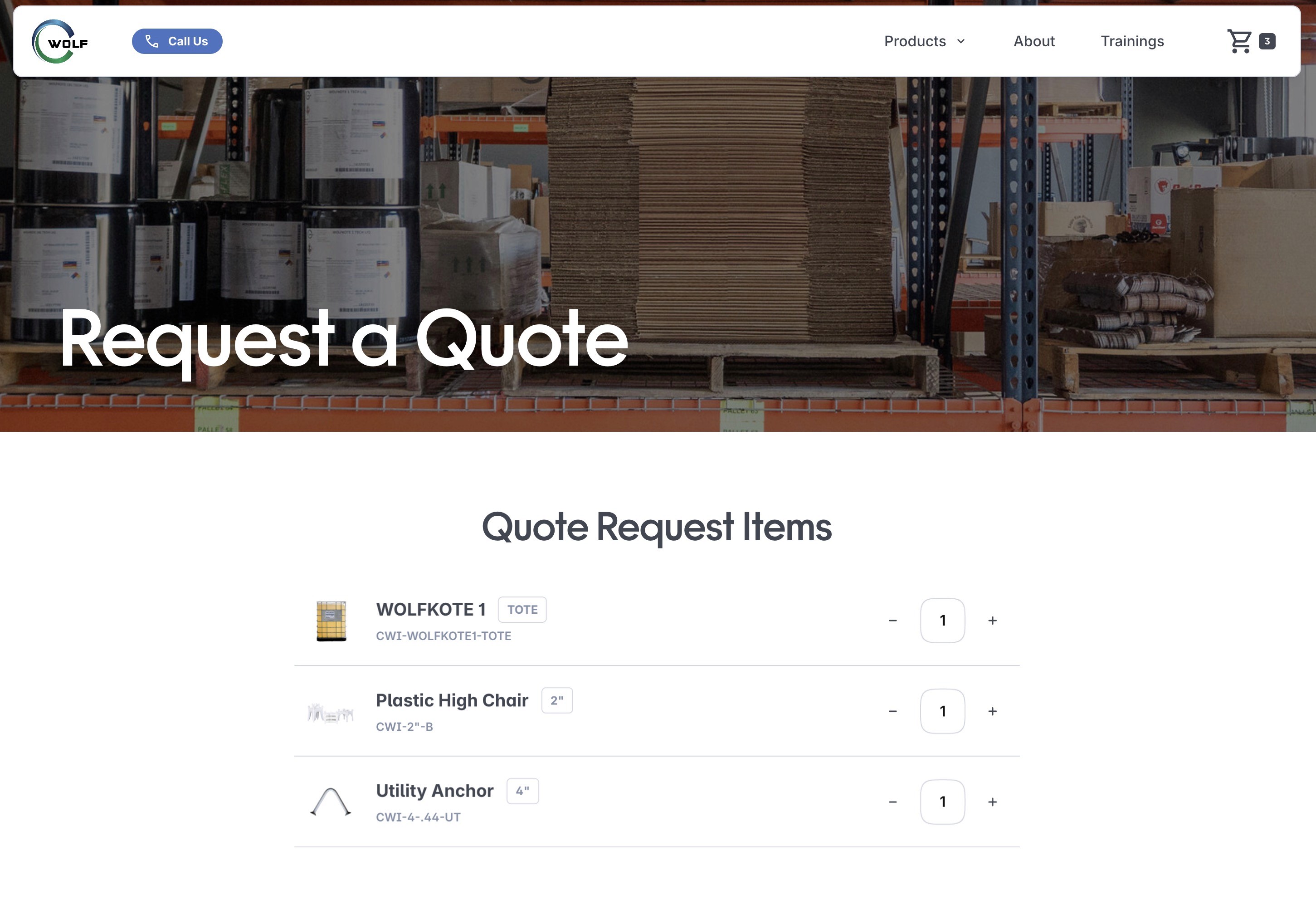
Initially I looked at building a bespoke quote form for each product. Unfortunately that falls apart fast: 42 products with variants means dozens of form states to wire and maintain, and no shared cart logic between them. The reframe was to stop treating "quote request" as a form problem and treat it as a cart problem with the money taken out. Framer has a feature called Pseudo Cart, an add-to-cart system meant for storefronts. I used it as a quote builder instead. A buyer adds products to a list, the list behaves like a cart, and submitting it sends a quote request instead of charging a card.
The build
The catalog runs on four CMS collections. (A CMS, content management system, is the database Framer reads product data from so the site builds itself from records instead of hand-built pages.)
Categories, Products, Variants, Properties. Products link to their variants and to a Properties table for the spec grid, so one template renders every product page from its own data.
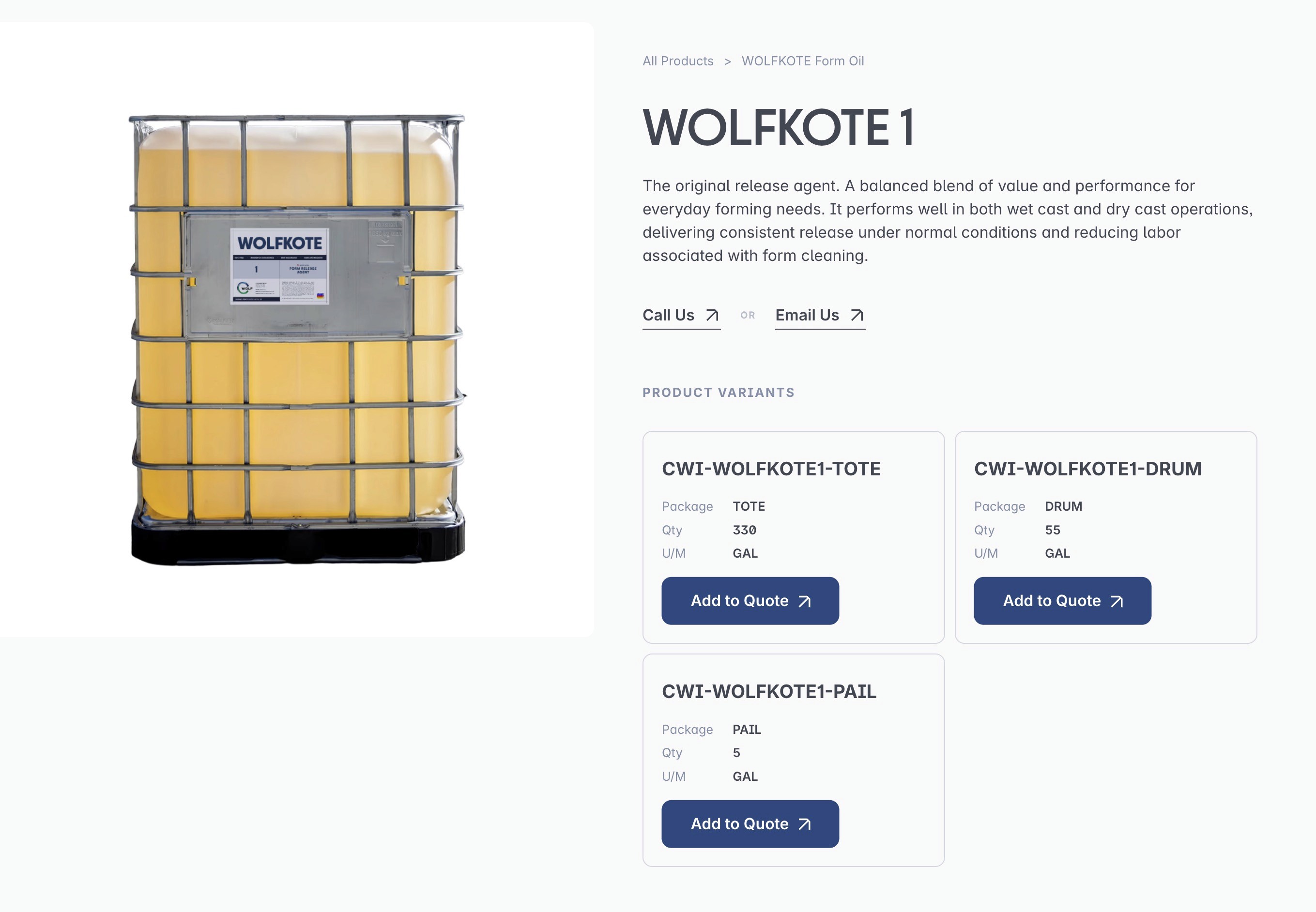
The quote funnel on Pseudo Cart. Add to quote, review the list, submit. The submission routes to the client's inbox as a structured request.
A filtered Categories page.
/categoriesfilters the catalog by line. Mid-project the client decided they'd rather land buyers on the WOLFKOTE category view than a long product list, so I pointed the nav's Products link straight at it and kept "View all products" going to the full index.
One honest constraint worth naming: Pseudo Cart bakes a price field into the cart system. On a quote funnel there is no price, but the field can't be pulled without rebuilding the entire flow. I flagged it rather than promise a clean removal, and we left it handled in the background instead of chasing a rework that wasn't worth the cost. (Knowing where a tool's floor is matters as much as knowing its ceiling.)
The motion and the cleanup
My first design direction leaned on heavy dark sections stacked down the page. In a later revision round I stripped most of them back to a lighter, cleaner layout, and the read was immediate: it looks far better without the dark blocks fighting each other. Roby Fitzhenry, AlwaysCreative's founder and the lead on the account, agreed and we shipped the lighter version.
On motion, I kept it functional, which is the right register for an industrial brand. Nav and footer links underline on rollover so every clickable thing announces itself. The quote drawer opens as an overlay over the current view rather than routing to a new page, so adding a product and reviewing the list never blanks the screen. The fussiest part was the cart on smaller breakpoints (a breakpoint is the screen width where the layout switches between desktop, tablet, and mobile). Because the quote drawer is a dynamic page, resizing the browser mid-session could confuse its state, so I tuned the mobile and tablet versions until the flow held on a real device.
Launch day, and the email I broke
Publishing to the client's own domain meant pointing it at Framer, which meant changing nameservers to get into the DNS settings. What I didn't know was that their email ran on the same domain through HostGator. The nameserver change took the site live and knocked their email offline at the same time.
Roby flagged it within hours. I traced it back to the nameserver swap, walked through what happened on my end so he could explain it to the client cleanly, and we got the records pointed back so email recovered. Not the launch I'd planned, but it taught me to ask where a client's email lives before I ever touch their nameservers. That question is now a standing line on my pre-launch checklist.
Results
First 90 days on the live domain (March 11 to June 9, 2026):
433 unique visitors and 1.9K pageviews, at a 45.5% bounce and a 5m24s average session, which is long for a catalog and reads as buyers actually working through the product pages.
Desktop-led, 288 desktop against 137 mobile (8 tablet). The opposite of a consumer store, and exactly the B2B signal you'd want: people researching from a work machine. It also validated keeping the layout desktop-first.
Search-driven discovery. 114 visits from Google, plus Bing, DuckDuckGo, and Yahoo. Buyers are finding an industrial supplier by searching, not by paid push.
The catalog and the quote page both pull. The WOLFKOTE line drew 65 visits to its category page and 45 to its lead product, and
/request-quotepulled 35 visits in the window.The client reports regular quote submissions coming through the funnel, which is the number that actually pays for the site.
What changed
Pseudo Cart as a quote funnel is now my default pattern for any catalog that needs to capture leads instead of process payments: industrial suppliers, wholesale, made-to-order, anything where price is a conversation. The trick isn't a new tool, it's using the cart you already have and removing the checkout. I reach for it now without hesitating, which is the whole point of having built it once under real constraints.